Every Science begins as philosophy and ends as an art
Every Science begins as philosophy and ends as an art. Acceptance of EV by end customers is intrinsically hinged on two factors – Original Equipment Manufacturers (OEMs) and Charge Point Operators (CPOs). Having enjoyed the choices offered by OEMs on the ICE platform (which has evolved over 100 years), customers would expect to have a bouquet of products on the EV platform as well to choose from, as each one of us has varying needs when it comes to buying a vehicle for personal use. Simultaneously, customers would like to be assured of a charging facility as most of the present breed of EVs have having limited range of 150-300km which is otherwise quite good to meet daily needs, but 100 years of use of ICE vehicles have created that urge of not getting worried for undertaking long distance road trip at our wish.
Given the limited consumption of e-vehicles in India currently, the infrastructure for the same is also at a nascent stage. Consumers would like to be confident about charging the vehicles as per their convenience, at the location of their choice, and at a price commensurate with service. Currently, the foremost concern for a driver of an electric vehicle is what they would do if they are stuck in a jam and the battery is showing low. If adequate and appropriate EV quick charging stations are available within cities as well as along highways, it would alleviate such concerns. A robust charging station network would give them confidence, and that would work as a pull effect for OEMs, as well. This warrants that a ubiquitous, reliable, and safe public charging network is created.
Principles of Charging
Before I delve into how and what kind of charging infrastructure should be built in our country, it is important to understand how a vehicle gets charged. All vehicles driving on electric power terrain have a battery that supplies energy to the traction/propulsion motor. So, it is a battery fitted in a vehicle that gets charged using an electric supply.
As we know battery requires DC (Direct Current) to get charged, whereas electricity supply generally is AC (Alternating Current). It means that for the battery to receive the appropriate type of current for its charging, the AC supply has to be converted to a DC supply for the battery. This is done by an AC-DC converter. This converter is typically fitted in a car, which is called an “On-Board Charger”. This mode of charging using an On-Board Charger is called AC charging. When this conversion happens outside the Car/Vehicle, the On-Board Charger gets bypassed, and DC is directly supplied to the battery fitted in the vehicle. This mode of charging is called DC Charging. So, technically, there is no AC charger as the charger is built on board, not outside the vehicle. However, in common parlance, we term AC charging when the On-Board charger gets an AC supply either from a wall socket directly or through Electric Vehicle Supply Equipment (EVSE), and the On-Board Charger converts AC to DC and the battery gets charged.
A charging point is a point of supply of electric current in an appropriate form to a battery, either through an On-Board Charger or directly. A charging station is a facility where one or more charging points or EVSEs are located, and there is a facility for vehicles to remain parked while getting charged. Generally charging station is used with reference to public charging or captive charging for a dedicated group of vehicles. A charging station can be identified in terms of the level of power output, the mode of charging, and the Type of Charging station (or EV) Connector. Here I am taking charge based on the level of power output delivered by the charger to understand the need for a charging network.
Charging Type
The level of charging refers to the power level of the charging outlet. Based on this, it has been classified as Level-1, Level-2, and Level-3 charging.
- Level 1 charging –
Plug-in Vehicles get charged by drawing an AC supply using a household wall socket. Delivered power is the product of voltage and current supply, which is generally restricted to less than 3.3 KW. This charging is done in a single phase. In India, this could be a 230V 15 amp supply. This will take quite longer time to fully charge a car, requiring a frequently overnight plugged status of the vehicle. Time in full charging will depend on the battery size of the vehicle and also the On-Board charger capacity. A typical Mahindra e2o would take about 9-10 hours, whereas Hyundai Kona and MG ZS would take 12-15 hours.
- Level 2 charging –
The Power capacity of EVSE in Level-2 could vary from 7 KW to 43 KW. Charging at 22 KW and above in this mode is also termed as AC fast charging. This charging is done using 240V with amperage ranging from 30 amp to 80 amp in single to three-phase, delivering a higher rate of charging compared to Level-1 charging. A battery fitted with a small battery pack, like the Nissan Leaf, takes 30 amps, whereas a Tesla charger delivers 80amps. Please note that it is still AC charging as it is the capacity of the On-Board Charger, which will determine how much power it will accept from the EVSE. Level-2 charging is generally located in shopping malls, golf fields, cinema halls, parking places, and similar locations where we are expected to spend a reasonably long time while the vehicle gets charged. Depending upon battery capacity and EVSE power capacity, cars like the Hyundai KONA and MG ZS can get charged in 6-7 hours.
- Level 3 charging –
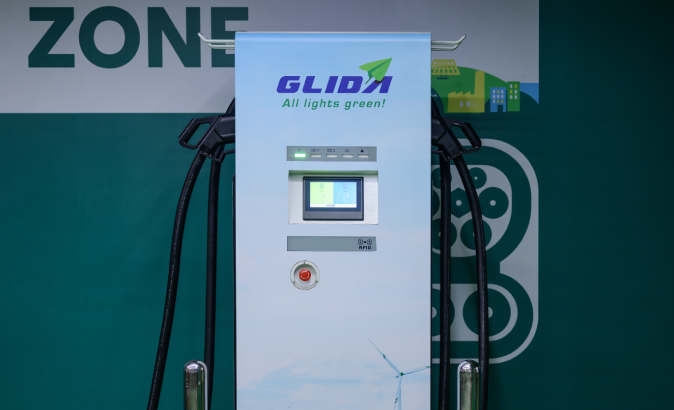
This is also known as DC fast charging or DC quick charging. This is high amperage, high voltage – typically 400 volts plus. Power delivered is generally 50 KW and above. The purpose of this charger is to charge up to 80% of the battery pack in less than an hour. The Hyundai KONA and the MG ZS are the vehicles that can be charged with such chargers. In DC fast charging, it is standard practice to refer time needed for charging the battery pack only up to 80% capacity, as beyond that it takes a longer time. Batteries in vehicles like Mahindra e-Verito and Tata Tigor are designed to take not more than 72 volts with current as high as 200 amps. Since it is low-voltage charging, the time taken for full charging of these electric cars is about 90-120 minutes, depending on battery pack size.
Charging stations can also be classified according to the location where chargers are installed.
Home Charging
EV charging for home, where the electric car is plugged in to charge while it is parked, typically overnight. Compared to destination charging, it is generally cheaper – or better for the wallet; as well as slower – or better for the battery. Home charging is the obvious alternative for private homes, garages, and housing societies with dedicated parking spaces.
Destination Charging
Destination charging is the term used to describe charging stations away from the home electric car charging station. These are typically located at shops, malls, hotels, park-and-ride parking lots, service stations, and restaurants at destinations. Destination chargers tend to be quick chargers or semi-fast ones, depending on the location. Electric vehicle quick charge station (50kW) can fill a battery from zero to 80% in approximately 30-40 minutes, and are necessary when travelling greater distances, particularly along highways, or for businesses such as taxis and postal delivery services. Electric vehicle fast charger or flexible charger (up to 22kW) take approximately three to four hours to charge a battery to 80%, and are frequently found around shopping centres, office parking lots, and street-side.
Requirement for Charging Network
Developing a large-scale charge point network in the Indian urban environment will be more challenging. Unlike a petrol station where serviceability of the station is quite high, due to a faster rate of fuel filling, a Charging station, especially an electric car charger for home, would cater to a smaller number of vehicles in a given time. It means we need a large number of charging points to cater to an equivalent number of vehicles. This warrants a huge parking space. Further, it requires adequate electricity infrastructure to supply power to the vehicle at the desired rate. As the adoption of EVs is likely to be in Urban centers during the initial years of adoption, both availability and cost of space and electricity infrastructure are high. Further, EV charging would be a different proposition.
Unlike oil and CNG, this has interdependency on battery and electricity. An appropriate communication is needed between the battery and charger, and the charger and grid to ensure the safety & reliability of the vehicle and the grid. This necessitates that the charging infrastructure must be smart. What is needed is a greater and urgent push for upgradation and strengthening of the electricity infrastructure, along with charging infrastructure. India would require adding lakhs of charging points year on year if all vehicles function electrically in the future.
Present Situation of Charging Infrastructure in India
Unlike developed countries where EV refers primarily to electric Cars, in India, EV has to cater to various segments of automobiles -2W, 3W, and 4W. Hitherto, battery chemistry for the 2W, 3W segment, and 4W segments has been Lead Acid and Li-ion, respectively. Lead Acid and Li-ion batteries have different characteristics in terms of charging.
Lead Acid batteries are generally charged at a slow rate, most often overnight, which does not make a good use case for a public charging network, though it can be good from a grid point of view. Li-ion batteries have the capability of getting charged at a high/very high rate. However, 2W and 3W vehicles do not prefer to have fast charging Li-ion batteries, as it makes the product costlier at the present state of battery development. This leaves 4W (passenger car vehicles, buses, and other commercial vehicles) as a candidate case requiring a public charging network.
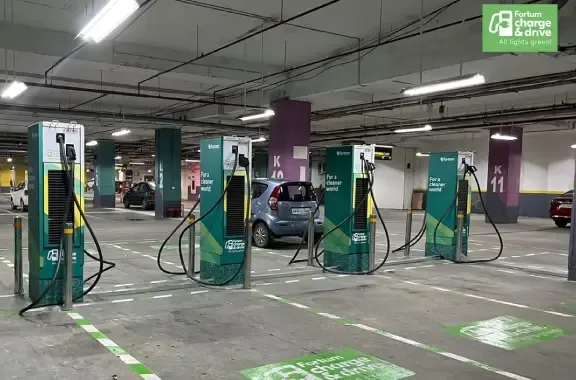
Keeping this in view, most of the public charging and captive charging networks have come up to serve 4W cars and buses. DHI notified the standards for chargers for low-voltage battery systems, and these are called Bharat Charger AC001 and DC001. Charger conforming to AC001 delivers 3.3KW per connector, whereas those conforming to DC001 or equivalent give a power output of 10/15 KW per connector. With the introduction of high-voltage battery cars like the Hyundai KONA and MG ZS in the market, the need for 50KW DC chargers has emerged. Fortum has set up 10 such chargers in five cities at 10 locations in public charging mode to cater to such cars.
Outlook for Charging Infrastructure
Globally, charging technology has matured, and CPOs have started offering charging at 150-350 KW level, which can charge a compatible car in less than 10 minutes to give 125-150km range. This kind of charging would need robust electricity infrastructure, which is neither needed at this stage for India, nor is it commercially feasible presently in India. However, once EVs become mainstream, consumers would like to prefer these kinds of chargers as this would not only alleviate range anxiety but also reduce the space requirement as one charger can serve 5-6 times more vehicles than the 50 KW chargers.
Another development that is taking shape at the global level is wireless charging. This would be very helpful for the fleet, particularly at locations where drivers are waiting in a queue for their turn, like at the Airport. Wireless charging will offer continuous charging to the vehicles while it is waiting and moving in the queue. This would remove the need to plug the cars into the charger inlet.
How we can create a Robust Charging Infrastructure
Private charging and workspace charging are obvious to pursue. In this direction, the Ministry of Housing and Urban Affairs, Government of India’s proposed guidelines to permit the establishment of private charging stations at residences are a welcome step. However, the future lies in public charging. Space is a prized commodity in India, particularly in urban centres. The average per capita space in India is 100 sq. feet. 70% of cars in major cities such as Delhi and Mumbai are parked on roads. So, to derive better economic value, public charging makes more sense than a home EV charging station, which would cater to a single car, opposite to public charging, where one unit of space can cater to a greater number of cars. For a resource-stretched country, public charging, thus, should be the priority. The solutions, though, should be bespoke, and charging infrastructure providers will have to take cognizance of that. For example, in workplaces, cars can be charged at an AC electric vehicle fast charging station, and at places like shopping malls, where a consumer spends 2-3 hours, a slow charger of 7-22KW can be installed. A one-size-fits-all approach cannot work here, and a mix of fast chargers and slow chargers will be able to serve the consumers, according to their particular needs.
Charging stations should be capable of servicing all kinds of vehicles. On this front, India needs not reinvent the wheel. On the DC Fast charging front, globally two leading standards – CHAdeMO and CCS- are widely accepted, and the same can be adopted/adapted for 4-Wheeler segments. On the AC side of charging, Type-2 charging would make the charging station completely interoperable. Fortunately, this issue has been settled after a protracted discussion among stakeholders. Very soon, we will master the art of developing charging stations in India.