GLIDA Lounge
-
01-May-23
-
 Back
Back
Electric Vehicles – The Next Big Source of Renewable Power Demand
Glida India has been at the forefront of #electricmobility, providing industry and users access to our knowledge base, advocacy, and community meets in addition to practical support and reliable advice.
To contribute to the #ElectricVehicles sector’s holistic growth and to create a better value proposition for EV users, we focus on helping players across the value chain in their efforts to succeed, transform, and grow.
Mercom India Renewables Summit 2023
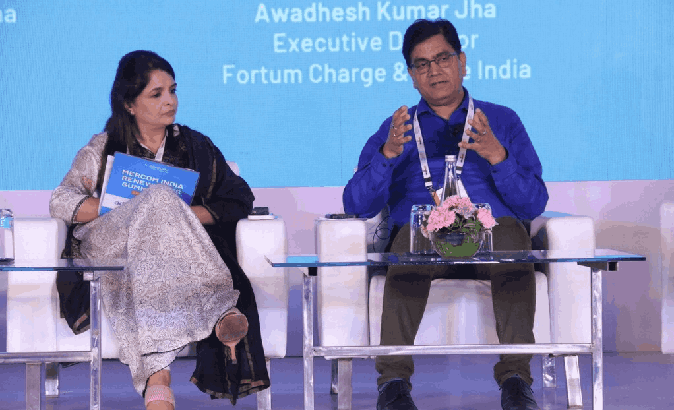
Shri Awadhesh Kumar Jha was invited to speak on a distinguished panel at the Mercom India Renewables Summit 2023 in New Delhi, organised by Mercom India, to share his views on Electric Vehicles – The Next Big Source of #RenewablePower Demand. He is well known as an insightful, purpose-driven #thoughtleader with a keen sense of the Indian and global EV movements.
He began by emphasising that #EVcharginginfrastructure has been keeping up with the growing number of electric vehicles in India, particularly in the passenger vehicle segment where a widespread and reliable public charging network is essential for enabling EV users’ movement “free from any hesitation.”
He noted that India needs distinct #charginginfrastructure for its 2W, 3W, 4W, and #ebus segments, as each has varying #battery capacities and use cases. Cars are often used for long distances, where without adequate public charging, EV users lack the confidence to fully utilize their vehicles.
India currently has around 2,000–3,000 DC fast chargers catering to about 60,000 #electriccars capable of accepting DC fast charging — roughly a ratio of one charge point for every 20–30 cars, which aligns with #globalstandards. This is further supplemented by approximately 6,000–8,000 AC charging points.
He added that both private and public sector entities have been contributing to the creation of #publiccharging networks. The #privatesector, notably, has been developing without government subsidies — an encouraging sign reflecting confidence in the business’s medium to long-term viability, assuming that car sales continue to rise rapidly.
EVs and Renewable Energy: A Perfect Partnership
Shri Jha outlined that EVs and #renewableenergy are perfect complements. Greater renewable adoption — from #solar and #wind — will make the #grid greener and further clean the EV journey. Even with India’s current #energymix, EVs remain significantly cleaner than internal combustion engine vehicles over their lifecycle.
He explained that passenger EVs, with large battery capacities (~30 kWh and above), could provide balancing storage for variable renewable sources like solar. As solar generation grows, India’s daily load curve is increasingly resembling the “duck curve,” with net load dips during the day.
Since most cars remain stationary during the day (at homes or offices), they can absorb excess solar energy. When these cars return home in the evening — India’s peak demand period — they can feed energy back into the grid. This would help avoid costly investments in additional #storage capacity.
That’s why Shri Jha emphasised that #India should begin preparing for #V2G (Vehicle-to-Grid). He urged #OEM charger manufacturers, car makers, and CPOs (Charge Point Operators) to collaborate to make this vision a success. He highlighted the need for #bidirectional chargers and V2G-enabled vehicles, supported by standards like IEC15118 for communication.
He further mentioned that the government should create a suitable regulatory framework for enabling #V2G, since it would require aggregation of energy through a third-party player.
India’s Energy Demand and EV Growth
In response to a question about India’s electricity needs to meet its target of 30% electric vehicle sales by 2030, he estimated around 6 million #electriccars on Indian roads by then. With an average battery size of 30 kWh, the additional energy demand would be around 19 billion units — just 1.5% of India’s current generation (~1,600 billion units). Thus, while overall generation won’t be a challenge, last-mile distribution infrastructure will need strengthening.
He cautioned against widespread unplanned home charging, as it could lead to underutilized grid investments. Instead, he recommended using load-balancing home chargers to manage household energy demand efficiently or encouraging #community charging solutions in parallel.
Driving India’s EV Future
He emphasised that there is no better time than now to embark on the EV journey. Shri Jha shared that Glida India operates 470 charging points across 20 cities and continuously strives to provide EV users with a seamless experience — empowering them to travel confidently across any distance without hesitation. Glida is also building a strong EV community that empowers users to demand excellence from industry service providers.
To explore his insights on #sustainabledevelopment, #cleantechnology solutions, and the #futureofmobility, follow him on LinkedIn.
Excerpts from the Session
Joseph Teja, Consultant at NITI Aayog, highlighted the need to develop public-private partnerships to encourage private sector participation in setting up #EVcharginginfrastructure.
Abhishek Dabas, CEO of Gentari Green Mobility India, said #renewables will play a key role soon, considering the exponential growth of the #EV sector.
You can view the detailed summit agenda here.
Useful Links
Visit Fortum India to learn more about sustainable energy initiatives.
Use Glida India Charging Stations without downloading the app, or through #RFID access.
We love hearing from you — reach out anytime at support@chargedrive.in.